On this page
A Claude Code agency is a software team that builds client software with Claude Code, Anthropic's coding agent. Every agency can install the same tool, so the tool is not the difference. The difference is what the agency has configured around it and which parts of that configuration can actually stop a bad change. This post shows ours, feature by feature, with a link to Anthropic's documentation for each, and the questions to ask anyone else you are considering.
Every feature below links to Anthropic's Claude Code documentation as at November 8, 2026, with the release that introduced it from the Claude Code changelog.
What a Claude Code agency is, and what it is not
Claude Code is a product of Anthropic. An agency using it is a customer, not a partner, unless it can show otherwise. We are independent of Anthropic.
What an agency adds is a delivery system around the agent: who approves the plan, what runs before a tool call, who reviews the change and what has to pass before it merges. Our full lifecycle is on the AI SDLC page; this post covers only the part that runs inside Claude Code.
The Claude Code features we use
Hooks: the only part that can stop work
Hooks are scripts Claude Code runs at set points: when a prompt is sent, before and after each tool call, at session start and end, and around compaction. Anthropic released them in v1.0.38. A hook can return a decision that blocks the action, which makes hooks the one place a rule is enforced rather than requested.
We use hooks for both. The blocking ones are in the table further down. The advisory ones add context, for example a warning about a stale branch or a pointer to the documentation for the file being edited.
Plan mode: a person approves the plan first
In plan mode Claude Code proposes a plan and changes nothing until it is approved. We add a hook on top: after approval, the first file edit is held until the approved plan is saved to the project's plan record, so the plan the engineer approved is the one the work is checked against at the end.
Skills and slash commands: procedures written once
Skills are written procedures, with scripts and reference files, that Claude Code loads when a task calls for them. Support arrived in v2.0.20, and Anthropic announced Agent Skills on October 16, 2025. Our standard setup carries 19 skills, for planning, bug triage, security testing and site standards, and 46 slash commands, so a step such as opening or reviewing a pull request is one named command rather than a fresh prompt each time. Skills guide; they do not enforce.
Subagents and worktrees: review in a fresh context
Subagents run with their own context, so a reviewer has not seen the reasoning that produced the change it is checking. Custom subagents arrived in v1.0.60, and agents running in an isolated git worktree in v2.1.50. We use separate reviewer agents in parallel, and parallel changes are built in isolated copies of the repository and merged one at a time. The reviewers report; an engineer decides.
MCP servers and plugins: tools the agent can use
The Model Context Protocol, which Anthropic introduced on November 25, 2024, connects Claude Code to outside tools. We connect browser testing, documentation lookup and a map of the codebase. We also use plugins from Anthropic's own marketplace for browser testing and GitHub; the plugin system shipped in v2.0.12, announced on October 9, 2025.
CLAUDE.md and settings: team rules in every session
CLAUDE.md files load standing rules into each session, and one settings file configures each engineer's machine the same way. Anthropic's own docs treat CLAUDE.md as context, not enforced configuration, and so do we: a rule that must hold gets its own hook.
Headless runs: lessons a person approves
After a session, a headless run of Claude Code proposes lessons learned as new rules. Nothing is applied until a person approves it, which keeps the rules readable and owned.
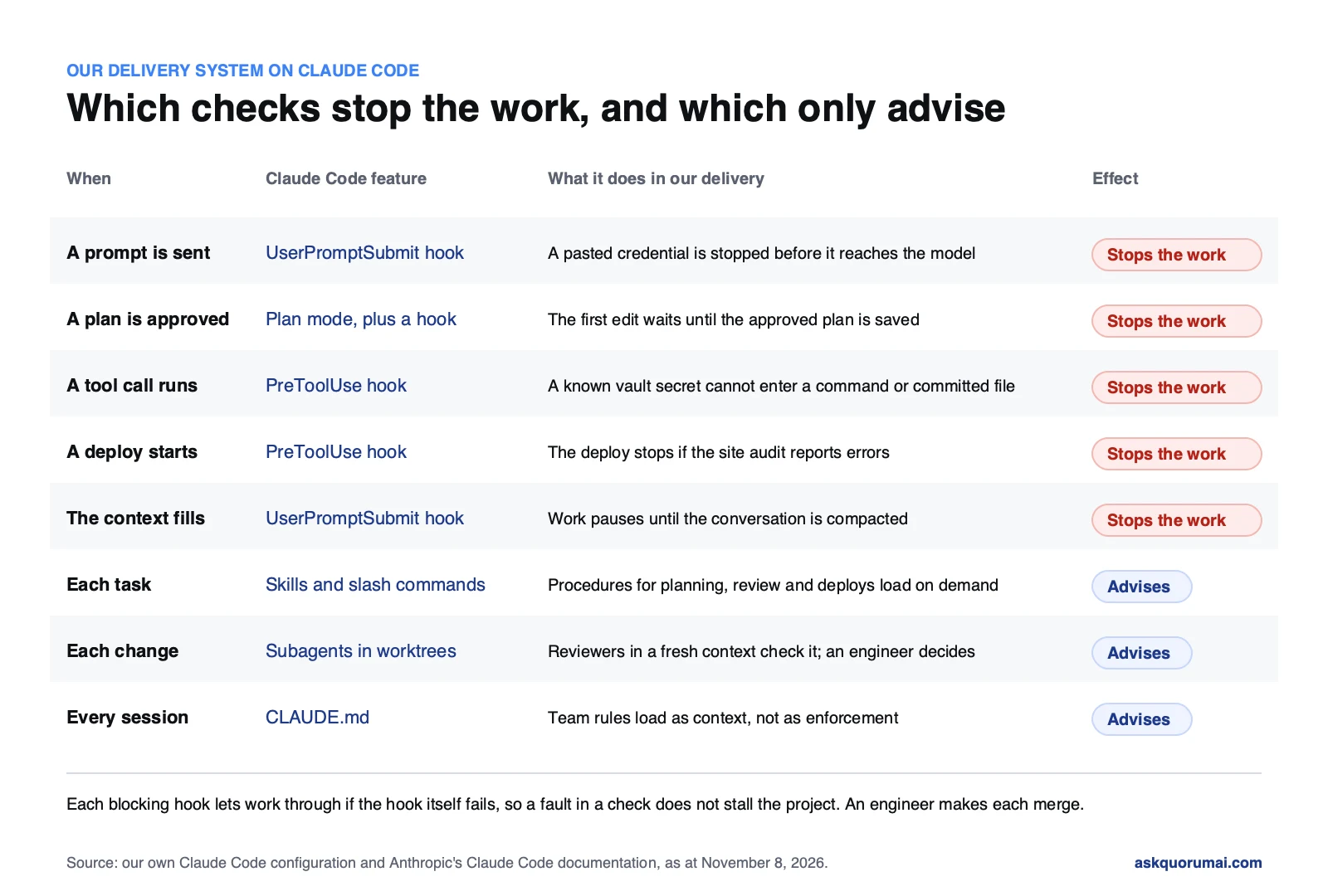
Which checks stop the work, and which only advise
| When | Claude Code feature | What happens | Effect |
|---|---|---|---|
| A prompt is sent | UserPromptSubmit hook | A pasted credential is stopped before it reaches the model | Stops the work |
| A plan is approved | Plan mode, plus a hook | The first edit waits until the approved plan is saved | Stops the work |
| A tool call runs | PreToolUse hook | A known vault secret cannot go into a command or a committed file | Stops the work |
| A deploy starts | PreToolUse hook | The deploy stops if the site audit reports errors | Stops the work |
| The context fills | UserPromptSubmit hook | Work pauses until the conversation is compacted | Stops the work |
| Each task | Skills and slash commands | Written procedures load on demand | Advises |
| Each change | Subagents in worktrees | Reviewers in a fresh context report findings | Advises |
| Each session | CLAUDE.md | Team rules load as context | Advises |
Two limits, stated plainly. First, each blocking hook lets work through if the hook itself fails, because a broken check that stalls a project gets switched off. Second, the secret check blocks values it knows from the vault; for secret-like text it does not recognise, a separate scanner warns and does not block. Neither replaces the engineer who reviews the change, and the quality gates that must pass before it merges are run by that engineer.
Questions to ask any Claude Code agency
- Which of your checks block, and which only advise? A weak answer is "everything is enforced". Most of a typical Claude Code setup is advisory.
- Can you show me the hook configuration? A weak answer is a diagram with no file behind it.
- What happens when one of your hooks fails? Any honest answer is fine. No answer means nobody has thought about it.
- Where do client secrets live, and what does the agent see? Look for "names, not values".
- Who approves the plan, and who merges? Look for a named role, not "the AI".
- Are you an Anthropic partner? If the answer is yes, ask for proof. If it is no, that is normal.
For the wider questions about cost, ownership and handover, see questions to ask an AI development company.
Where an engineer still decides
Claude Code writes and checks a lot of our code, and senior engineers remain accountable for the work. They approve the plan, read the review findings, make the merge and own the handover. The configuration above makes the safe path the default; it does not replace judgement.
Claude and Claude Code are trademarks of Anthropic, PBC. AskQuorum AI is independent and is not affiliated with or endorsed by Anthropic.
Common questions
A software team that builds and maintains client software with Claude Code, Anthropic's coding agent, using its own configuration of hooks, skills, subagents and review steps. What separates one agency from another is that configuration and the engineers who own the result, since every agency has access to the same Claude Code.
No. We build on Claude Code as a customer, the same way any team can. We are independent and not affiliated with or endorsed by Anthropic. Be careful with any agency that implies otherwise without showing it.
A hook can do either. Claude Code lets a hook block a tool call or a prompt, or just add context. In our setup five checks block and the rest advise. Each blocking hook lets work through if the hook itself fails, so the check is a strong default, not a guarantee, and an engineer still reviews the change.
Secrets stay in a vault on the engineer's machine and the AI works with their names, not their values. A hook stops a pasted credential before it reaches the model, and another blocks a tool call that would put a known vault value into a command or a committed file. A separate scanner warns on secret-like text it does not recognise, but it does not block.
Hooks, because they are the only part that can stop work rather than suggest. Then plan mode, so a person approves a plan before code changes; skills and slash commands, so procedures are written once; and subagents, so review happens in a fresh context. CLAUDE.md is useful, but Anthropic's own docs describe it as context, not enforcement.
Law and guidance as at 8 November 2026. This is general information, not legal advice.