On this page
Claude Fable 5.2 arrived on November 9, 2026, and it is now in the model selector for everyone on a Team plan. It is Anthropic's model for long, open-ended technical work, and it writes responses up to 30% faster than Fable 5.1. Opus 5.5 stays the default. What matters for an admin is not the model but the money: how much of it each seat may use, what happens on November 16, and whether your usage credits are set up the way you think they are.
We received this as an admin notice from Anthropic for our own Team plan. Every limit, date and setting below is checked against Anthropic's documentation, linked in each section, as at November 10, 2026.
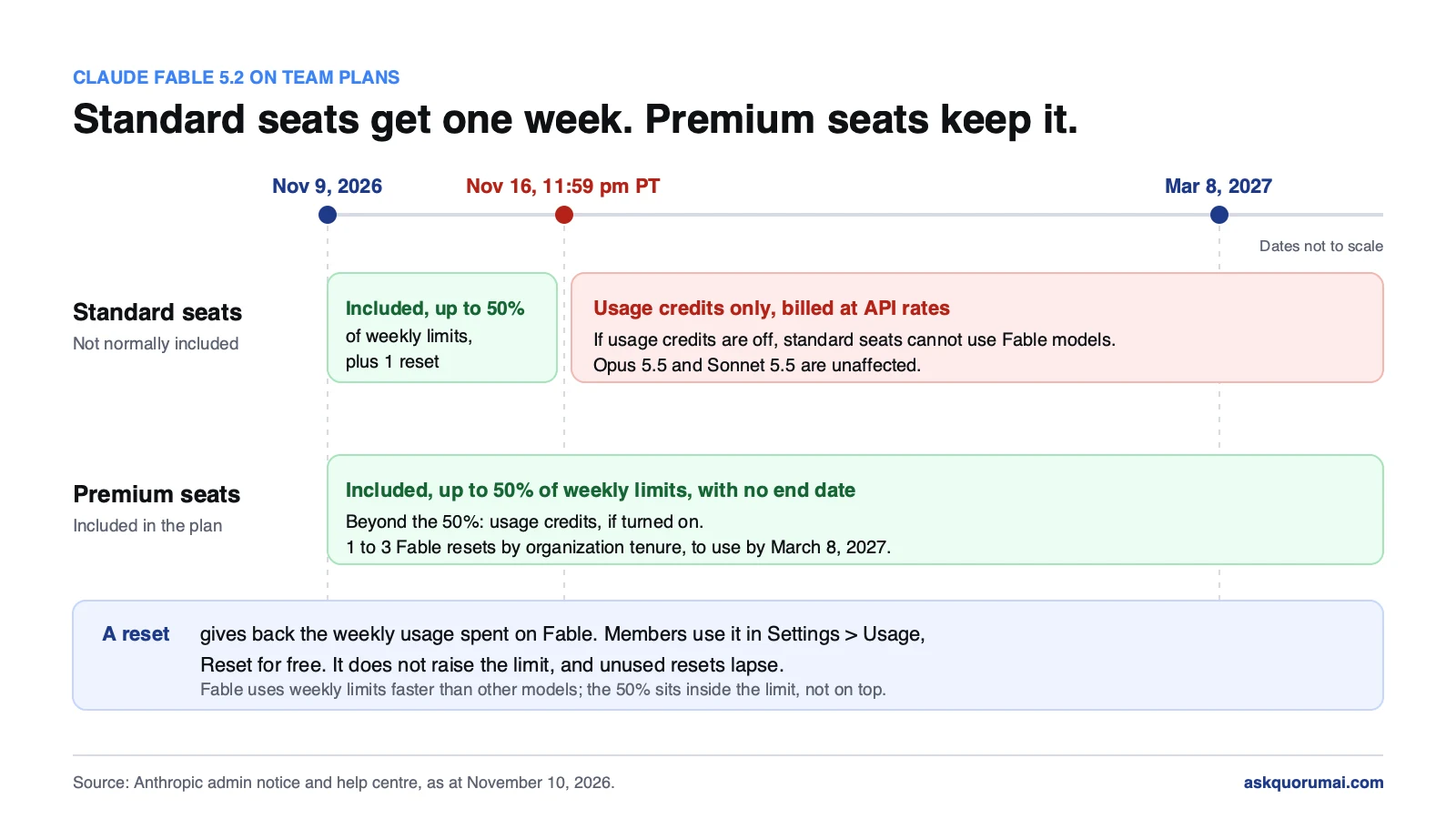
At a glance
| Seat type | Fable 5.2 included | Fable limit resets | After that |
|---|---|---|---|
| Standard | Up to 50% of weekly limits, until November 16 | One, to use by November 16 | Usage credits only, if turned on |
| Premium | Up to 50% of weekly limits, ongoing | One to three, to use by March 8, 2027 | Usage credits, if turned on |
1. What Claude Fable 5.2 is for, and when to pick it
Anthropic describes Fable 5.2 as a model for ambitious technical work: large coding projects, scientific research, data and financial analysis that can take hours. It checks its own work as it goes, which is what makes it suited to tasks nobody watches step by step.
Anthropic's notice to Team admins sets out the three models side by side:
| Model | Best for |
|---|---|
| Fable 5.2 | Long technical tasks: large coding projects, scientific research, financial analysis that runs for hours |
| Opus 5.5 (the default) | Complex tasks that need careful judgment, such as changes across a large codebase or an important report |
| Sonnet 5.5 | Clearly defined everyday tasks: building and fixing features, short documents, summary slides, spreadsheets |
The trade-off is usage. According to Anthropic's Fable models article, Fable models draw from the same weekly limits as everything else and use them faster than other Claude models. The 50% is a ceiling inside your weekly limit, not extra on top of it. A member who spends half the week's allowance on Fable by Tuesday has half left for every other model.
That is why Opus 5.5 staying the default is sensible. The pattern we would suggest to most teams: keep Opus for daily work, and switch to Fable for the task that is long, hard and worth the allowance.
On the API, Fable 5.2 is claude-fable-5-2, priced at $8 per million input tokens and $40 per million output tokens, down from $10 and $50 for Fable 5.1.
2. Standard seats: one included week, then usage credits
Standard seats on Team plans do not normally include Fable models. For the launch, Anthropic's launch offers article gives them a week:
- All Fable models included until November 16, 2026 at 11:59 pm PT, up to 50% of each member's weekly usage limits.
- One Fable limit reset for eligible members, which lapses at the same time.
After November 16, or sooner if a member reaches the 50%, Fable usage on a standard seat is billed to the organization's usage credits. If usage credits are off, members on standard seats cannot use Fable models at all. Nothing breaks for Opus 5.5 or Sonnet 5.5; Fable simply stops being available to them.
So the real decision for an organization with standard seats is one of three:
- Let Fable lapse. Leave usage credits off. Standard seats lose Fable on the 17th and carry on with Opus and Sonnet.
- Pay for it. Turn usage credits on, with a spend limit that reflects how much Fable work you expect.
- Upgrade the seats that need it. If a few people will use Fable every week, a premium seat includes it, where credits bill every token.
3. Premium seats: 50% included, and up to three resets
Premium seats on Team plans include Fable models as part of the plan, up to 50% of each member's weekly usage limits, with no end date. Beyond that share, members can keep using Fable on usage credits, if they are on.
For the launch, premium seats also get one to three Fable limit resets, to use by March 8, 2027 at 11:59 pm PT. The number depends on how long the organization has paid, measured from its first paid bill, so every premium seat in one organization gets the same number:
| Organization subscription length | Fable resets per premium seat |
|---|---|
| Under 6 months | 1 |
| 6 to 12 months | 2 |
| Over 12 months | 3 |
Resets go only to accounts with paid billing in place before November 9, 2026 at 10:00 am PT. A team that subscribed after that does not get them.
4. How a Fable limit reset works
A reset gives back the weekly usage a member has spent on Fable models, and refills the five-hour limit too where one applies. Three details are easy to get wrong:
- It is manual. Members use it themselves in Settings → Usage, by selecting Reset for free. Nothing happens automatically.
- It does not raise the limit. It returns what was spent. A member at the 50% ceiling who resets is back to their full Fable share, not above it.
- Unused resets lapse. On standard seats that is November 16; on premium seats, March 8, 2027.
A reset covers every Fable version, so it works whether a member is on Fable 5.2, 5.1 or 5. The practical advice for members: save the reset for the week you start a large piece of work, not the first time you hit the ceiling.
5. Usage credits: what to review before November 16
Usage credits are what members draw on once their included usage runs out. On Team plans, Anthropic's usage credits article puts every control under Organization settings → Usage, and only Owners, Primary Owners and custom roles with the Billing permission set to "Can manage" can change them.
| Setting | What to check |
|---|---|
| Usage credits | On or off. Off means standard seats lose Fable after November 16 |
| Monthly spend limit | The organization-wide ceiling. Can be a fixed amount or unlimited |
| Spend limits by user | A per-member ceiling, useful for the one person who will run Fable all week |
| Auto-reload | Tops the balance up when it falls to the amount you set. Check it is not set higher than you intend |
| Who can use credits | The whole organization or specific members |
Two facts make this worth an hour of attention. Credits are billed at standard API rates, so Fable beyond a seat's included share costs the same as it would on the API. And purchased credits expire 12 months after purchase and are non-refundable, so a large top-up you do not use is money gone.
6. Claude Fable 5.2 in Claude Code
Fable 5.2 needs Claude Code v2.1.321 or later. Update first, then choose the model with /model. Older versions will not offer it: Fable 5.1 needs v2.1.255 and Fable 5 needs v2.1.170.
The usage rules are the same as in chat, because Claude Code draws on the same weekly limits. A long agentic session on Fable spends allowance quickly, which is exactly the work Fable is for and exactly why a spend limit matters. If your team already runs Claude Code under managed settings, as we described in our post on how a Claude Code agency works, decide whether Fable belongs in the models you allow. If you went through the fast mode change on November 1, this is the same kind of decision: a new option that costs more, and a setting that decides who gets it.
Telling your team
A short note saves a week of questions. Something like:
Claude Fable 5.2 is now in the model selector. Use it for long technical work: large coding projects, research and analysis that runs for hours. It uses your weekly limit faster than Opus 5.5, which stays the default and is still the right choice for everyday work. [Standard seats: Fable is included until November 16; after that, ask before using it.] [Premium seats: you have resets in Settings → Usage, to use by March 8, 2027.]
Keep the line that applies to your seats and delete the other.
The checklist
- Count your standard and premium seats, and who on each will want Fable.
- Decide what standard seats get after November 16: nothing, usage credits, or an upgrade to premium.
- In Organization settings → Usage, check usage credits are on or off as you intend.
- If they are on, set the monthly spend limit, any per-member limits, and check auto-reload.
- Make sure developers are on Claude Code v2.1.321 or later.
- Tell your team which model to use for what, and where their resets are.
For a team that already treats model choice as a policy, this is a short job. For one that does not, Fable 5.2 is a good reason to start, because the most capable model is now also the one that spends your budget fastest.
Common questions
Anthropic's newest Fable model, released on November 9, 2026. It is built for long, open-ended technical work such as large coding projects, scientific research and financial analysis, and it checks its own work as it goes. It writes responses up to 30% faster than Fable 5.1. On the API its model ID is claude-fable-5-2.
On premium seats, yes, for up to 50% of each member's weekly usage limits. On standard seats it is included only until November 16, 2026 at 11:59 pm PT, up to the same 50%. After that, standard seats can use Fable models only with usage credits, and only if the organization has turned them on.
A reset gives back the weekly usage a member has spent on Fable models. It does not raise the limit itself, and it covers Fable 5.2, 5.1 and 5. Members use it themselves in Settings, Usage, by selecting Reset for free. Standard seats get one reset that lapses on November 16, 2026. Premium seats get one to three, depending on how long the organization has paid, to use by March 8, 2027.
It depends on the organization's subscription length, measured from its first paid bill. Under six months gets one reset, six to twelve months gets two, and over twelve months gets three. Every premium seat in the organization gets the same number. Resets go only to accounts with paid billing in place before November 9, 2026 at 10:00 am PT.
The included week ends, and Fable usage on standard seats is billed to the organization's usage credits. If usage credits are off, members on standard seats cannot use Fable models. If they are on, they are used automatically, so review the monthly spend limit and auto-reload before the 16th.
On the Claude API, $8 per million input tokens and $40 per million output tokens, down from $10 and $50 for Fable 5.1. Usage credits on Team plans are billed at standard API rates, so Fable usage beyond a seat's included share costs the same.
Anthropic positions Fable 5.2 for long technical tasks that can run for hours, Opus 5.5 for complex work that needs careful judgment, and Sonnet 5.5 for clearly defined everyday tasks. Fable uses weekly limits faster than other models, and Opus 5.5 stays the default, so most teams keep Opus for daily work and pick Fable when a task is long and hard.
Claude Code v2.1.321 or later. Update first, then choose the model with /model. Fable 5.1 needs v2.1.255 or later, and Fable 5 needs v2.1.170 or later.
Law and guidance as at 10 November 2026. This is general information, not legal advice.