On this page
Google made Gemini 4 Carbon generally available on November 10, 2026, and two days later added Gemini 4 Hydrogen, a faster and cheaper model for everyday agentic work. For a business team already on Claude, or choosing an AI model for the first time, the question is not which model tops a chart this week. It is which one does your work, at what cost per finished task, and what it would take to change your mind later.
Every price and date below is taken from Google's and Anthropic's own pages, linked in each section, as at November 16, 2026. Where a vendor quotes a benchmark, we say whose claim it is.
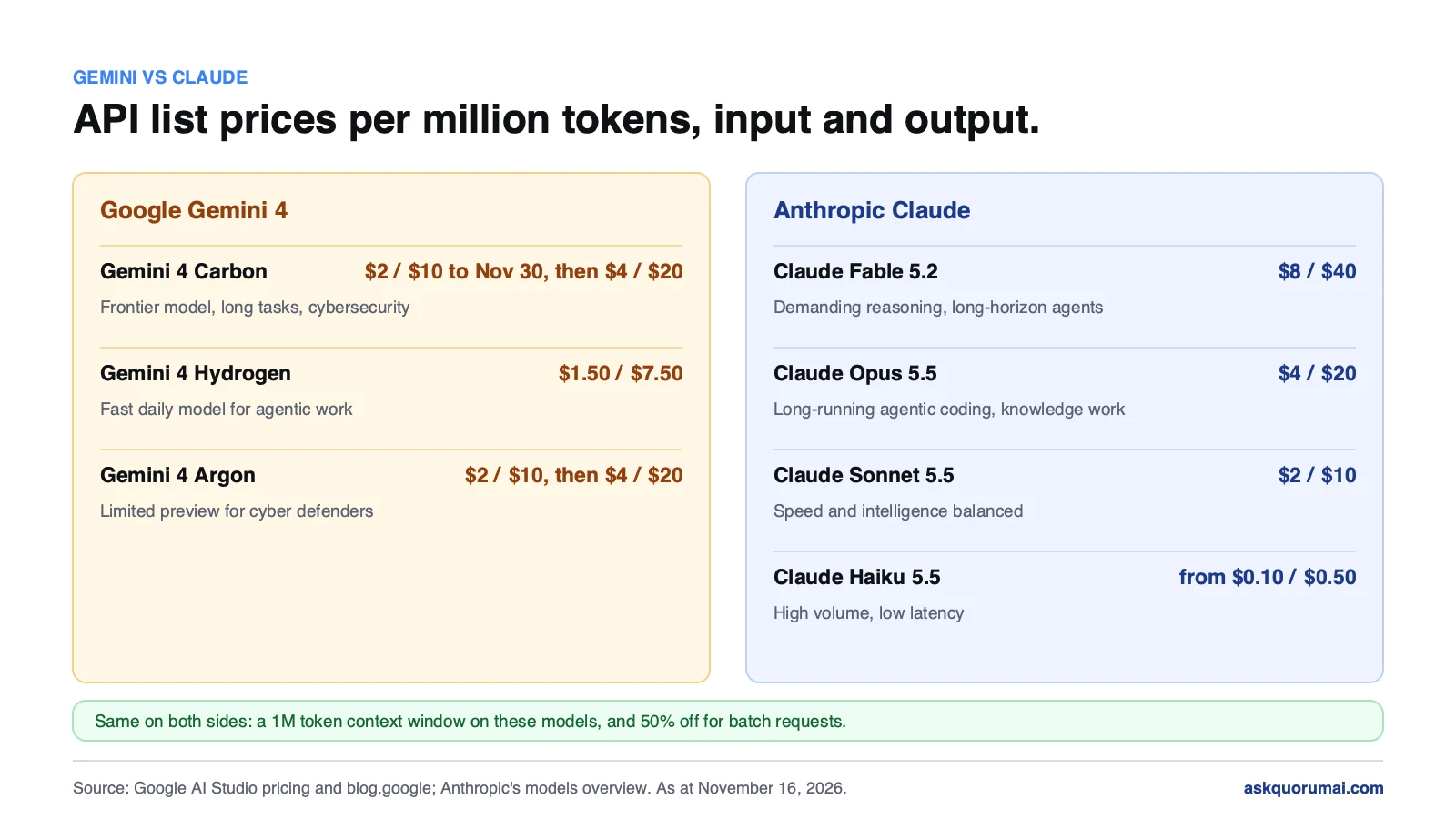
At a glance
| Gemini 4 Carbon | Gemini 4 Hydrogen | Claude Opus 5.5 | Claude Sonnet 5.5 | |
|---|---|---|---|---|
| Positioned for | Long, multi-step work, cybersecurity | Fast everyday coding and agents | Long-running agentic coding and knowledge work | Speed and intelligence balanced |
| Input / output per million tokens | $2 / $10 to November 30, then $4 / $20 | $1.50 / $7.50 | $4 / $20 | $2 / $10 |
| Context window | 1M tokens | 1M tokens | 1M tokens | 1M tokens |
| Batch discount | 50% | 50% | 50% | 50% |
1. What Gemini 4 Carbon and Gemini 4 Hydrogen are
Google now ships three Gemini 4 models, and they are not the same product.
- Gemini 4 Carbon is the one most teams will test. Google's launch post calls it its strongest model, built for long, multi-step work: software engineering, scientific research and cybersecurity analysis. It is in Google AI Studio, the paid tier of the Gemini API, Gemini for business, the Gemini app and AI Mode in Search.
- Gemini 4 Hydrogen, announced on November 12, is the fast model. Google describes it as a daily driver for agentic workflows, with Carbon and Argon kept for deep, long-horizon reasoning. It is in the Gemini API, AI Studio, Gemini for business, Google Sheets and the Gemini app.
- Gemini 4 Argon, announced on September 30, is still in limited preview for a set of trusted cyber defenders. Most teams cannot use it yet.
Google also reports strong scores for Carbon on coding, automation and security tests, including blocking 99% of attack trajectories in its own simulated cyberattack testing. These are Google's numbers on tests Google picked. Anthropic does the same for Claude. Treat both as a reason to try a model, never as proof it suits your work.
2. Gemini 4 Carbon pricing against Claude
On the Gemini API pricing page, Carbon costs $2 per million input tokens and $10 per million output tokens until November 30, 2026, and $4 and $20 after that. Batch requests are half price, and there is no free tier.
Anthropic's models overview lists the current Claude line:
| Claude model | Input / output per million tokens | Anthropic's description |
|---|---|---|
| Claude Fable 5.2 | $8 / $40 | Demanding reasoning and long-horizon agentic work |
| Claude Opus 5.5 | $4 / $20 | Long-running agentic coding and knowledge work |
| Claude Sonnet 5.5 | $2 / $10 | The best combination of speed and intelligence |
| Claude Haiku 5.5 | from $0.10 / from $0.50 | High-volume, latency-sensitive tasks |
Read the two together and the launch price makes sense. Until November 30, Carbon costs the same as Sonnet 5.5. From December 1 it costs the same as Opus 5.5. Hydrogen, at $1.50 and $7.50, undercuts Sonnet 5.5 on price per token.
Price per token is half the sum. The other half is how many tokens a model spends to finish the job: how much it thinks, how many tool calls it makes, how often it has to retry. A cheaper model that takes twice the turns is not cheaper. Our worked run rate for a support agent shows how quickly turns and caching move a monthly bill, and the same method works for any model.
3. Where each fits for a business team
Coding agents. Both vendors now aim their top models at long-running software work. If your engineers already work in Claude Code with written settings and hooks, that setup is part of the value, not just the model behind it. Our AI SDLC runs on Claude Code, and the Claude Fable 5.2 guide covers when the more expensive Claude model is worth it.
Long documents. The current Claude models and Gemini 4 Carbon and Hydrogen all list a 1 million token context window, so size alone no longer separates them. What separates them is how well each one uses the whole window on your documents, and that is a test, not a spec sheet.
Office work inside Google Workspace. Hydrogen is in Google Sheets, and both new models are in Gemini for business. If your team lives in Gmail, Docs and Sheets, a model that is already there removes a step for every person, every day.
Teams already on a Claude Team plan. Your members already have chat, Cowork and connectors in one place, as our guide to unified Claude on Team plans explains. Moving them means new habits, new admin settings and a second bill while you run both.
High-volume, simple tasks. Classification, extraction and routing rarely need a frontier model. Claude Haiku 5.5 and Gemini 4 Hydrogen are the models to price for these, and this is often where the biggest saving sits.
4. What a switch actually costs
The model fee is rarely the largest cost of changing models. Count these before you decide:
- Prompts and system instructions. Prompts tuned for one model often behave differently on another. Budget time to retest them.
- Tool and connector definitions. An agent that calls your systems has tool definitions, permissions and error handling built around one API. Review your connector settings on either side before turning them on.
- Evaluation. Without a set of real tasks with known good answers, you cannot tell whether the new model is better or just different.
- People. Seats, training, admin settings and a period of running both.
A build that keeps the model behind one internal interface, with its own test set, turns the next switch into a configuration change and a test run. That is worth doing even if you never switch, because the next release from either vendor will ask the same question again. Open tools such as DeepSeek Harness already connect to several providers, which shows how common this is becoming.
5. Gemini vs Claude: a decision table
| If your situation is | Start by testing | Why |
|---|---|---|
| Your team works in Google Workspace all day | Gemini 4 Hydrogen and Carbon in Gemini for business | The model is already where the work happens |
| Your engineers use Claude Code with written settings | Claude Opus 5.5, with Fable 5.2 for the hardest work | Your setup, hooks and habits carry over |
| You need high volume at low cost | Claude Haiku 5.5 against Gemini 4 Hydrogen | Simple tasks rarely need a frontier model |
| You are building a product feature on an API | Two models side by side on your own test set | Cost per finished task decides, not list price |
| You are testing Carbon this month | Carbon, budgeted at $4 and $20 | The introductory price ends November 30 |
How we help teams choose
We follow model releases from Anthropic, Google and open-source projects, and our posts on Claude Fable 5.2, unified Claude and DeepSeek Harness are written as the changes land, checked against the vendor's own pages. We build production software with LLMs and agents built in where they earn their keep, and in our own delivery a second reviewer checks each change using a different model family where available, so no single model marks its own work.
For your team, that means a short, testable answer: which model for which job, what it will cost per finished task, and how to build so the next switch is cheap. That is part of our AI consulting work, and if the answer is a product feature, our SaaS AI feature integration team builds it.
The checklist
- List the jobs you want a model for, and keep simple ones apart from hard ones.
- Pick five real tasks per job, with an answer you would accept.
- Run each on two models: one Claude, one Gemini, at the same tier.
- Compare cost per finished task and the rework each output needs.
- If you test Carbon, budget at $4 and $20, not the launch price.
- Count the switch cost: prompts, tools, connectors, people.
- Keep the model behind one interface, so the next decision is cheaper.
Common questions
Google's strongest generally available model as at November 16, 2026. Google made it available on November 10, 2026 through Google AI Studio, the Gemini API, Gemini for business and the Gemini app, and describes it as built for long, multi-step work such as software engineering, scientific research and cybersecurity analysis.
On the Gemini API, $2 per million input tokens and $10 per million output tokens at its introductory price, which runs until November 30, 2026. After that it is $4 per million input tokens and $20 per million output tokens. Batch requests are 50% off. Google's pricing page lists no free tier for Carbon.
Google's fast model for everyday coding and agentic work, announced on November 12, 2026. Google calls it a daily driver, with Carbon and Argon as the frontier models for deep reasoning. It costs $1.50 per million input tokens and $7.50 per million output tokens, flat across a 1 million token context window, and has a free tier on the Gemini API.
It depends on the tier you compare. Gemini 4 Carbon at its introductory price matches Claude Sonnet 5.5 at $2 and $10 per million tokens, and from December 1 it matches Claude Opus 5.5 at $4 and $20. Claude Fable 5.2 costs $8 and $40. Gemini 4 Hydrogen at $1.50 and $7.50 sits below Sonnet 5.5 on price. Price per token is only part of the cost; the number of tokens a model uses to finish your task matters as much.
Not on a launch announcement alone. Run both on a sample of your own tasks, compare cost per finished task and the rework each output needs, and count what a switch would touch, such as prompts, tool definitions, connectors and team training. If you already pay for Google Workspace or a Claude Team plan, the tools your people use every day weigh more than a small price gap.
Both vendors now pitch their top models at long-running coding work, and both publish results on benchmarks they choose. A benchmark tells you which model to try, not which one to buy. Test on a slice of your own codebase, including the review and fix-up time after the model finishes, before you move a team.
For the current models, yes in size. Google lists a 1 million token context window for Gemini 4 Carbon and Gemini 4 Hydrogen, and Anthropic lists 1 million tokens for Claude Fable 5.2, Opus 5.5, Sonnet 5.5 and Haiku 5.5.
Law and guidance as at 16 November 2026. This is general information, not legal advice.